Lecture 2 - Roles, topology, and network formation
Course: Zigbee guide | Phase 2 - Embedded Software, IoT
Previous: Lecture 01 - What Zigbee is and where it fits | Next: Lecture 03 - The Zigbee stack: ZDO, APS, endpoints, and clusters
The three main node roles
Zigbee networks are built from three main node types:
- Coordinator
- Router
- End Device
Official reference: Silicon Labs network node types
Coordinator
There is at most one coordinator in a Zigbee network.
Its job is to:
- form the network
- choose channel and identifiers
- anchor the network
- often act as the trust center
In practice, the coordinator is usually the gateway-like or mains-powered central node.
Router
Routers:
- forward traffic
- extend network range
- allow children to attach
- stay awake instead of sleeping aggressively
A router is infrastructure, not a battery-first endpoint.
End Device
End devices:
- do not route traffic for others
- usually communicate through a parent
- are the natural place for battery-powered sensors and actuators
Some end devices are sleepy, which matters a lot for power design later.
Topologies: star, mesh, and hybrid reality
Zigbee is often described as "mesh", but the useful engineering point is more specific:
- a coordinator can anchor a network
- routers can relay traffic
- end devices can hang from a parent
That means real deployments often look hybrid, not like one pure textbook diagram.
Official reference: Silicon Labs Zigbee mesh networking
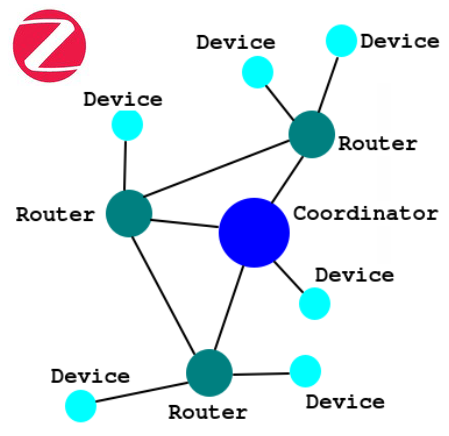
This picture is useful because it shows the role split visually:
- one Coordinator at the center
- several Routers extending the network
- several leaf Devices hanging from routing infrastructure
Source: eMcU Home Automation Zigbee topology image
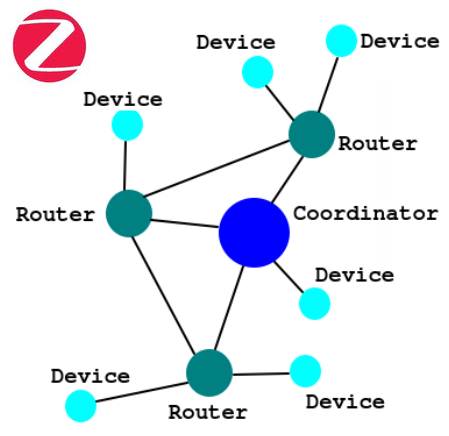
In practice:
- a small deployment may behave almost like a star
- a larger deployment uses routers for reach and resilience
- sleepy end devices remain leaves
So the real question is not "is it star or mesh?" but:
- who routes?
- who sleeps?
- who forms the network?
- where are the failure points?
How a Zigbee network forms
At a high level:
- a coordinator scans and selects a channel
- it creates the network
- routers and end devices discover and join
- parents are selected
- routing state develops as the network grows
This is the basic bring-up flow you must hold in your head before touching SDK examples.
Key detail:
- the coordinator has special formation responsibility
- once the network exists, routers and parent relationships matter more for daily operation
Trust center and management implications
The coordinator is not just the first router.
In many Zigbee deployments it also acts as the trust center, which means it is central to:
- authorization
- key handling
- network admission
That is one reason coordinator design quality matters so much. If the coordinator is weakly implemented, the whole network suffers.
The embedded-design consequence
When you choose a Zigbee role in firmware, you are not making a cosmetic setting. You are choosing:
- power behavior
- RAM/flash pressure
- radio duty cycle
- routing responsibility
- security responsibility
That is why roles belong in Embedded Software, not only in networking diagrams.
Lab
Draw a small 6-device Zigbee network and label:
- one coordinator
- two routers
- three end devices
Then answer:
- which nodes must stay awake?
- which nodes can reasonably sleep?
- which node is most likely to act as trust center?
Previous: Lecture 01 - What Zigbee is and where it fits | Next: Lecture 03 - The Zigbee stack: ZDO, APS, endpoints, and clusters